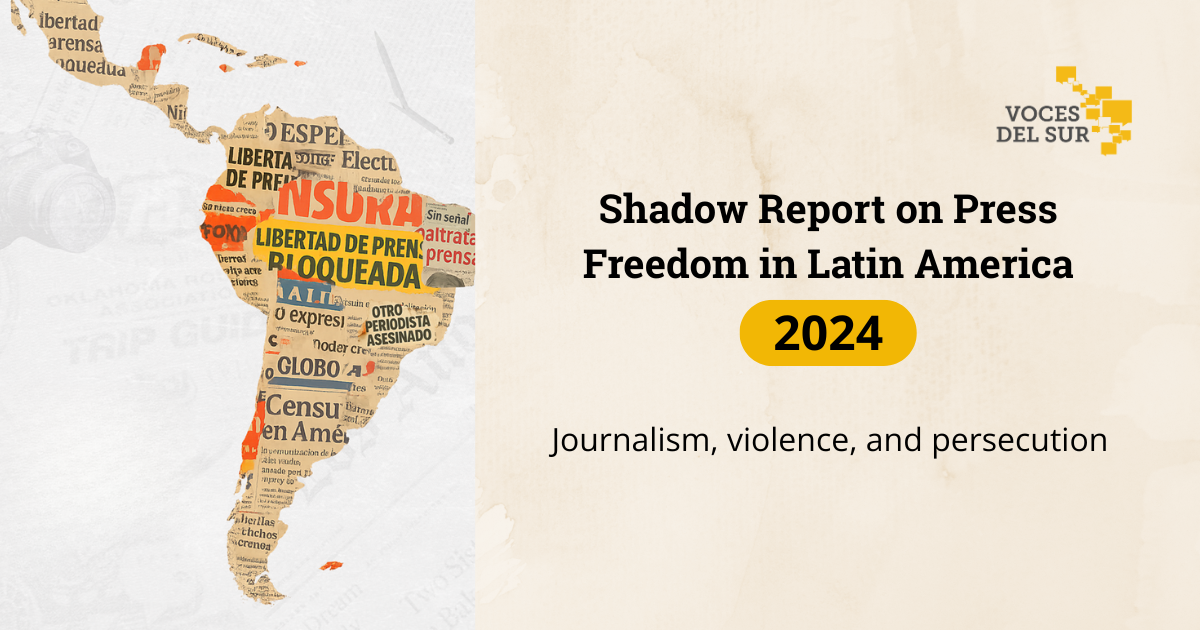
Latin America, October 1, 2026 (Red Voces del Sur). – In 2024, a total of 3,766 attacks on the press were documented in 17 countries across Latin America: Argentina, Bolivia, Brazil, Chile, Colombia, Costa Rica, Cuba, Ecuador, El Salvador, Guatemala, Honduras, Mexico, Nicaragua, Paraguay, Peru, Uruguay, and Venezuela. According to the seventh edition of the Shadow Report on press freedom in Latin America, state actors were responsible for 49.3% of these cases.
Although the total number of reported incidents decreased slightly compared to 2023, the new report warns that this does not indicate an improvement in the situation. Instead, it suggests a «rearrangement of attacks» and the consolidation of self-censorship, information deserts, and forced exile of journalists.
The 2024 Shadow Report, prepared by Red Voces del Sur (VDS), highlights a scenario of extreme risk, where state repression, organized crime, and systemic impunity threaten the right to information, ultimately weakening democracy in the region.
Red Voces del Sur is a network of 17 civil society organizations that work to promote and defend freedom of expression, freedom of the press, and access to information throughout Latin America. Red Voces del Sur was established in 2017 to develop a shared methodology for Indicator 16.10.1 of the UN Sustainable Development Goals (SDGs) to monitor violations of information freedoms and rights, counteracting official information from states.
Established in 2017, Red Voces del Sur developed a shared methodology to monitor violations of information freedoms and rights, as outlined in Indicator 16.10.1 of the UN Sustainable Development Goals (SDGs). This initiative aims to complement, and, at times, challenge official information provided by states.
Key findings from the 2024 Shadow Report:
- Rising lethal and extreme violence: 14 journalists were killed in the region, equivalent to one death every 26 days. Honduras, Mexico, and Colombia remain the most lethal territories. Additionally, cases of torture tripled, from 4 in 2023 to 12 in 2024. There were also 4 enforced disappearances and 8 kidnappings. Impunity for these crimes remains the norm, encouraging further violence.
- The state as a systematic aggressor: State actors were responsible for almost half of all recorded violations (1,681 alerts). Police and security forces perpetrated one in three «assaults and attacks,» the most frequent category, with 1,562 cases. Presidents such as Javier Milei (Argentina), Nicolás Maduro (Venezuela), and Nayib Bukele (El Salvador) were notable individual perpetrators in the region.
- Stigmatizing speech as a weapon: This was the second most common form of violence, with 756 registered alerts (20.1% of the total), which is double the frequency since 2020. More than half of stigmatizing discourses came from state actors, who used rhetoric to discredit the press, normalize hostility, and create a permissive environment for physical attacks.
- Judicialization for censorship: The use of the judicial system to intimidate journalists continued to rise, with 217 civil and criminal proceedings documented, a sustained increase in recent years. Colombia, Brazil, and Chile were the countries with the highest number of cases, where state actors initiated 61.1% of legal proceedings.
- Organized crime, a growing threat: Violence by criminal groups intensified, with 170 attacks registered, tripling their incidence since 2021. The live armed assault on the TC Television channel in Ecuador was a notable case that demonstrated the power of these groups to silence the press.
- Differentiated violence: 142 alerts of violence based on sex or sexual orientation were recorded, in which women journalists, indigenous communicators, and LGB journalists were disproportionately impacted. These attacks, often full of misogynistic and sexist content, seek to silence coverage of issues related to human rights, corruption, and women.
- Increase in information deserts: The report highlights the deepening censorship and «news deserts» in authoritarian regimes such as Cuba, Nicaragua, and Venezuela, where repression has forced hundreds of journalists into exile and left entire communities without access to independent information.
To view the complete analysis and country-specific data, please refer to the full report.